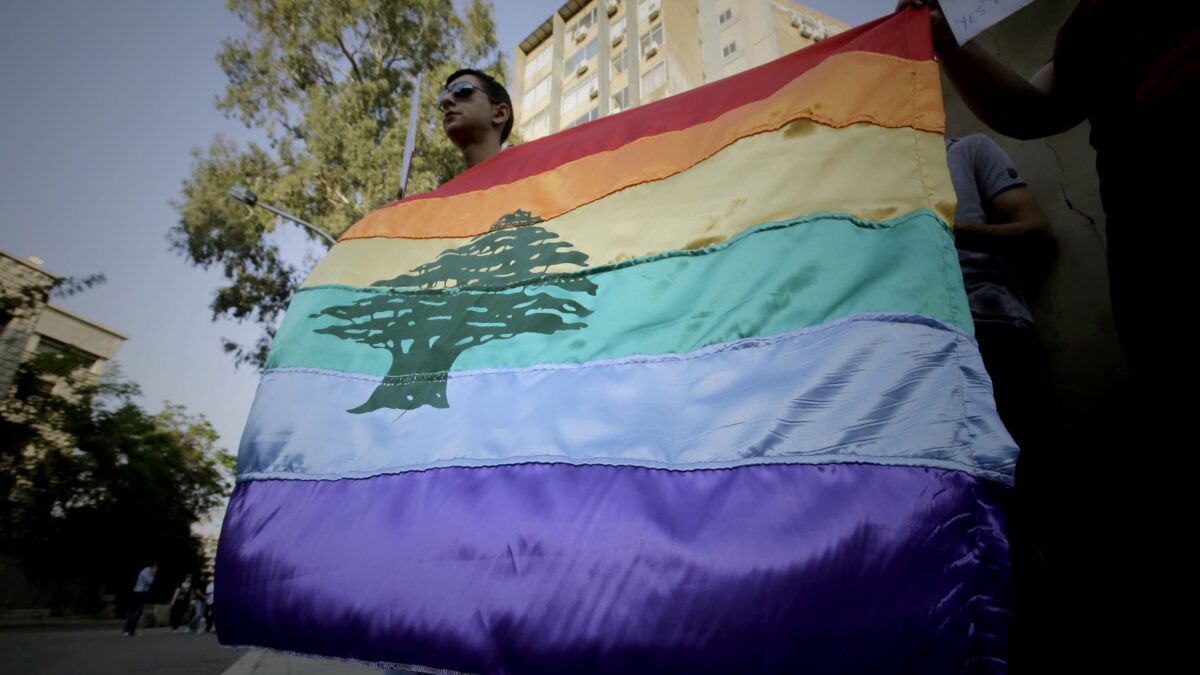
Lebanon military court rules homosexual sex not punishable by law in landmark decision

April 1, 2019

Lebanon’s top military prosecutor, judge Peter Germanos, acquitted four members of the military accused of sodomy Saturday — a landmark ruling that affirmed homosexuality is not a crime in the Middle Eastern nationThe Daily Star reported.

This victory for Lebanon’s gay community comes days before the April 3 date when Southeast Asian kingdom of Brunei plans to enforce legal measures that punish gay sex with death by stoningGeorge Clooney and Elton John called for the boycott of luxury hotels owned by the oil-rich country as a way to protest the Sultan of Brunei’s decision to implement sharia law, a form of extreme Islam.

Judge Peter Germanos dismissed the charges against the four men, accused of committing sexual acts “contrary to nature,” because Lebanon’s penal code does not define what “kind of relationship can be considered ‘contrary to nature,” Germanos explained to the Beruit-based newspaper.

Germanos also declined to issue arrest warrants for the four men. The outcome of Saturday’s case marked the first ruling by military prosecutors that establishes consensual gay sex is not punishable by law. Lebanese civilian courts previously affirmed consensual relations between people of the same sex was illegal.

In a separate case, an appeals court cleared the charges against nine people arrested in a Beirut suburb in July 2018 who were accused of violating Article 534 of Lebanon’s penal code, reported Al Jazeera. Those convicted of participating in sexual intercourse “contrary to the order of nature” can be sentenced to up to one year in prison.

Human Rights Watch, a U.S.-based human rights organization, said Article 534 is a “colonial relic” used to discriminate against Lebanon’s gay and transgender population.

Please check out the article on:

https://www.foxnews.com/world/lebanon-rules-homosexual-sex-not-punishable-by-law

Journalists devoted to coverage of the Supreme Court

06 September, 2021

Lorem Ipsum is simply dummy text of the printing and typesetting industry. Lorem Ipsum has been the industry’s standard dummy text ever since the 1500s, when an unknown printer took a galley of type and scrambled it to make a type specimen book. It has survived not only five centuries, but also the leap into electronic typesetting, remaining essentially unchanged. It was popularised in the 1960s with the release of Letraset sheets containing Lorem Ipsum passages, and more recently with desktop publishing software like Aldus PageMaker including versions of Lorem Ipsum.

Family law

In Lebanon, 18 different religious sects are officially recognized, four are Islamic, one Israeli and the others are all Christian sects. As a general rule, the basic criterion to resolve an internal conflict of laws and jurisdiction between these religious families is the faith of the involved person. If the prospective spouses are from different sects or even from different religions the marriage will be organized by the competent religious authority of the prospective husband, unless otherwise expressly stated by the parties to the marriage. The religious courts preside over cases of personal status and operate with very little government oversight. Because Lebanon’s constitution guarantees respect for “personal status and religious interests,” religious authorities have been keeping personal status laws under their control.


The Lebanese parliament passed a domestic violence law in 2014, which includes protection measures, such as restraining orders and policing and court reforms, as well as funding to enact the reforms. The law also introduced an official definition of domestic violence into the Lebanese criminal code. However, Lebanese women are still at risk of marital rape, which because of pressure from religious authorities, is not a part of the criminal code. A spouse’s threat or violence to claim “marital right to intercourse” is a crime, but the actual physical act is not.


There are extreme difficulties in returning a child from Lebanon when retained by a Lebanese parent. Lebanon is not a party to the Hague Convention on the Civil Aspects of International Child Abduction. There are no extradition treaties. Under Lebanese law, nationals may prevent their children from leaving Lebanon. Lebanon does not recognize international parental kidnapping as a crime. Issues of child custody and divorce in Lebanon are generally decided in religious courts under religious law. Thus, if the father is a Sunni Muslim and the mother is a Christian the custody of their children will normally be decided by a Sunni Muslim court. One might petition a civil court to handle a custody case instead of a religious court. The issue would be whether the religious court has jurisdiction. It could take up to two years to have the civil court assume jurisdiction and a minimum of four to five years to have the case decided. Among Sunni Muslims, the father has physical custody of a daughter over the age of nine and of a boy over the age of seven. For Shia Muslims the father generally has physical custody at for boys at age 2 and for girls at age 7.

If a father establishes that the mother is unfit or lacking good moral character, she will lose any right to the child. Muslim law requires a child to be raised in the Muslim faith, and if it were proven that a mother tried to raise the child as a Christian, she could be found unfit. Lebanon does not recognize dual nationality. Dual nationals who carry Lebanese papers will be treated as Lebanese nationals by security authorities. A child who is a dual American and citizen would be bound by Lebanese law in the eyes of the Lebanese civil courts.

If the marriage was made abroad before a civil institution, then the civil court of first instance in Lebanon is competent to look into the divorce case except if both parties are Muslims.

Criminal law

 Criminal Rates in Lebanon:

Level of crime 44.81 Moderate
Crime increasing in the past 3 years 71.09 High
Worries home broken and things stolen 37.81 Low
Worries being mugged or robbed 44.97 Moderate
Worries car stolen 45.21 Moderate
Worries things from car stolen 51.53 Moderate
Worries attacked 42.29 Moderate
Worries being insulted 44.85 Moderate
Worries being subject to a physical attack because of your skin color, ethnic origin, gender or religion 30.99 Low
Problem people using or dealing drugs 47.91 Moderate
Problem property crimes such as vandalism and theft 46.41 Moderate
Problem violent crimes such as assault and armed robbery 42.56 Moderate
Problem corruption and bribery 82.73 Very High

Safety in Lebanon


Safety walking alone during daylight


73.00


High

Safety walking alone during night 49.71 Moderate

Contributors: 249

Last update: November 2021

If the value is 0, it means it is perceived as very low, and if the value is 100, it means it is perceived as very high.

Lebanese criminal code:

https://www.anti-moneylaundering.org/Document/Default.aspx?DocumentUid=C18A1B78-046F-43AC-86D7-997EBE808C21

Criminal procedure code:

http://menarights.org/sites/default/files/2016-11/LBN_CriminalProcedureCode_ENG.pdf

Banking and finance

For nearly two years now, Lebanon has been assailed by compounded crises—specifically, an economic and financial crisis, followed by COVID-19 and, lastly, the explosion at the Port of Beirut on August 4, 2020.

Of the three, the economic crisis has had by far the largest (and most persistent) negative impact. The Spring 2021 Lebanon Economic Monitor finds that Lebanon economic and financial crisis is likely to rank in the top 10, possibly top three, most severe crises episodes globally since the mid-nineteenth century. In fact, Lebanon’s GDP plummeted from about US$55 billion in 2018 to a projected US$20.5 billion in 2021, while real GDP per capita fell by 37.1 percent. Such a brutal contraction is usually associated with conflicts or wars.

The banking sector, which informally adopted strict capital controls, has ceased lending and does not attract deposits. Instead, it endures in a segmented payment system that distinguishes between older (pre‐October 2019) dollar deposits and minimum new inflows of “fresh dollars.” The former is subject to sharp deleveraging through de facto lirafication and haircuts (up to 85% on dollar deposits). The burden of the ongoing adjustment and deleveraging is highly regressive, falling hardest on smaller depositors and Small and Medium Enterprises (SMEs). The Lebanese lira (LBP) continues to lose value as inflation rates remain in the triple digits. Inflationary effects are highly regressive factors, disproportionately affecting the poor and middle class. The social impact, already dire, could become catastrophic; more than half the country’s population is likely below the poverty line. Like poverty, unemployment is on the rise.  Lebanon has witnessed a dramatic collapse in basic services, driven by depleting foreign exchange (FX) reserves and the high cost of the FX import subsidies on food, fuel and medication. Acute shortages of fuel have led to severe electricity blackouts across the country, Further, medication is in severe shortage, while health services have suffered heavily.

Lebanon has also been dealing with the COVID-19 pandemic through intermittent lockdowns and other measures to mitigate the impact of the virus both on people and the already weak health system. Vaccination, launched on February 14 with initial financing from the World Bank, is progressing according to the National COVID-19 Deployment and Vaccination Plan. This aims to vaccinate 70% of the total population, citizens and non-citizens in a multi-phase rollout by the end of 2022. Efforts are underway to expand COVID-19 vaccination coverage and support vaccination deployment.

Beyond the human tragedy, the impact of the Port of Beirut explosion has had implications at the national level, despite its geographical concentration. These add to Lebanon’s long-term structural vulnerabilities, which include low-grade infrastructure—a dysfunctional electricity sector, water supply shortages, and inadequate solid waste and wastewater management—as well as weak public financial management, large macroeconomic imbalances, and deteriorating social indicators.

Immediately after the explosion, the World Bank Group, in cooperation with the United Nations (UN) and the European Union (EU), launched a Rapid Damage and Needs Assessment (RDNA) to estimate the impact of the blast on residents, physical assets, infrastructure and service delivery. The RDNA followed a “whole of Lebanon approach,” engaging public authorities, institutions and civil society organizations. The assessment found the value of damage was in the range of US$3.8 to US$4.6 billion, with losses to financial flows of US$2.9 to US$3.5 billion. The impact has been particularly severe in key sectors vital for growth, including finance, housing, tourism and commerce. Through to the end of 2021, the costs of recovery and reconstruction are expected to total US$1.8 to US$2.2 billion.

Building on the recommendations of the RDNA, in December 2020 the World Bank Group, EU and UN launched the Reform, Recovery and Reconstruction Framework (3RF) to address Lebanon’s immediate- and short-term needs. The 3RF outlines a costed, prioritized framework of actions needed to support recovery and reconstruction in Lebanon. Its aim is to “build back better” by adopting an integrated approach focused on people-centered recovery and preparing the ground for medium-term reconstruction, and on initiating key structural reforms based on the principles of transparency, inclusion, and accountability.

The Lebanon Financing Facility (LFF) was formally established on December 18, 2020 to kickstart the immediate socio-economic recovery of vulnerable populations and businesses affected by the explosion, and to support the Government of Lebanon in catalyzing reforms and preparing for medium-term recovery and reconstruction. The LFF will provide an important means to pool grant resources and strengthen the coherence and coordination of financing, in alignment with 3RF priorities. It will adopt flexible implementation modalities and strong fiduciary monitoring and oversight.

Building a better Lebanon requires swift and decisive action, particularly on reform. In the immediate term, Lebanon needs to adopt and implement a credible, comprehensive and coordinated macro-financial stability strategy within a medium-term, macro-fiscal framework. This strategy would be based on: (i) a debt restructuring program aimed at achieving debt sustainability over the medium-term; (ii) comprehensive restructuring of the financial sector toward regaining the solvency of the banking sector; (iii) new monetary policy framework aimed at regaining confidence in the exchange rate and its stability; (iv) phased fiscal adjustment aimed at regaining confidence in fiscal policy; (v) growth enhancing reforms; and (vi) enhanced social protection.

Over the medium-term, Lebanon has to prioritize building better institutions, as well as good governance and a better business environment, alongside physical reconstruction. However, given Lebanon’s state of insolvency (sovereign, banking system) and its lack of sufficient foreign exchange reserves, international aid and private investment will be essential to its recovery. The extent and speed to which aid and investments are mobilized will depend on whether the authorities and the Lebanese Parliament can act swiftly on the much-needed fiscal, financial, social and governance reforms. Without these, recovery and reconstruction cannot be sustainable, and the social and economic situation will continue to worsen.

The World Bank in Lebanon

Last Updated: Oct 17, 2021

Code of Money and Credit

http://www.databank.com.lb
Education law

Under the law, all Lebanese children should have access to education free from discrimination. Lebanon’s Law 220 of  2000 grants persons with disabilities the right to education, health, and other basic rights. It set up a committee dedicated to optimizing conditions for children registered as having a disability to participate in all classes and tests.

In reality, the educational path of children with disabilities in Lebanon is strewn with logistical, social, and economic pitfalls that mean they often face a compromised school experience—if they can enroll at all.

Administration of education system: Elementary, secondary, and higher education in Lebanon are all overseen by the Ministry of Education and Higher Education (MEHE) (Ministère de l’Education et de l’Enseignement Supérieur). Within the ministry are the:

  • Directorate General of Education
  • Directorate General of Higher Education
  • Directorate General of Technical and Vocational Education

Also under the auspices of the MEHE is the National Center for Educational Research and Development (CERD; CRDP in Arabic). CERD provides technical expertise on the Lebanese education system to both local and international bodies. It is also develops and issues textbooks related to the national curriculum.

Lebanon has both public and private schools. Both teach the national curriculum.

Technical and vocational education (TVET) is run separately from the rest of the education sector, under the direction of the Directorate General for Vocational and Technical Education (DGVTE). In 2012, the Lebanese government revised its approach to TVET fields, levels and certificates, issuing legislation and establishing a new framework focused on 4 areas:

  • Reviewing and upgrading programs and specialties
  • Reviewing and upgrading the academic structure of the TVET system
  • Developing qualified human resources, and upgrading financial and physical resources
  • Strengthening the sectors ties to local and private partners

Lebanon has low levels of education spending, both from a global and a local perspective. As noted in one 2014 report by BankMed, a Lebanon-based banking company, “the government spent in 2012 an amount equivalent to 1.6 percent of GDP on education. This amount compares to 3.8 percent of GDP spent on education in each of Kuwait and Egypt, 5.4 percent spent in Oman, and 6.2 percent spent in Tunisia.”